
Becoming a business owner is a very challenging undertaking. It takes boldness, decisiveness, risk tolerance, and a strong work ethic.
Unfortunately, it also comes with a penchant to do everything yourself. This can be a good thing if you are an expert in your field but not so much when you’re trying to build a brand new company from the ground up.
The same applies to business owners that dip their toes into web design for their business. In fact, a healthy percentage of our web design business comes from business owners that designed their own websites and are baffled as to why it never generates any revenue for them.
In this article, I’m going to take you through some of the many reasons why websites designed by non-web designers are generally doomed to fail and how you can avoid the same fate. The answers are going to surprise you, so keep reading!
Have You Heard Of Behavioral Psychology?
Ah yes, the one thing that the promise of web builders such as Wix, Squarespace, WordPress, and more always seem to leave out when it comes to how easy it is to build your own website.
The claim that you can build a website in just a few short hours using predesigned templates and just changing a little wording/branding. What could possibly go wrong?
As it turns out…quite a lot my friend!
The very first thing that can go wrong is not having a deep understanding of behavioral or consumer psychology.
Behavioral psychology is the study of how people act on their emotions and neurological responses to certain triggers. Web Designers can use this information in order to encourage certain user behavior which will then affect business metrics like traffic, engagement rates (or conversions), etc.
Not having insights into how the human brain processes information, comes to decisions, acts on information, or reacts to certain stimuli will put a ceiling on the effectiveness of any website.
Any professional web designer that is in demand for their skills will have a strong background in understanding how marketing and behavioral psychology influence how a website is designed.
Bottom line, if you want a website that gets results, you better have someone designing it that understands the right levers to pull to get you those results.
Web Design is Not Design
What if I told you that plumbers generally don’t make the best electricians?
That seems obvious, right?
The answer is so simple that you probably think a person would have to be nuts to assume those skills are translatable, after all, they don’t have anything to do with each other, do they?
Hold onto something sturdy cause I’m about to blow you away!
Plumbers and electricians both work on houses and commercial properties.
They are both unionized professionals here in the U.S.
They both have required apprenticeships or journeyman programs.
Both are highly skilled professions.
Both work with their hands and are regulated by licensing boards.
With all of these similarities, they should be able to do each other’s jobs competently.
Even though you may not be able to explain why they don’t transfer, you just know that they don’t.
The same comparison between these two very different skill sets applies to web design as well. Just because you’re a painter, a graphic designer, or work somewhere in a visual medium it doesn’t qualify you to create and design a successful website.
Sure some of the skills related to those professions might come in handy, but the discipline and knowledge required to be successful are completely different.
For those writers out there, you haven’t gotten off the hook either. Just because you did your graduate level thesis on “Development of methods and information technologies for creating systems of gestural communication”, does not mean you have a clue how to write a headline that will grab a consumer’s attention and keep it.
Understanding how users read web copy differently than from a book or other traditional publication plays a huge role in the types of content, typography, layout, logical hierarchy, and conversion paths a professional web designer must consider as part of their web design process.
Websites Are For Customers, Not Owners
One of the most challenging concepts for business owners to recognize is that they are their own worst enemy when it comes to designing their website.
They have a vested interest in getting out as much detailed information as possible. After all, they don’t want to risk a potential customer not knowing they provide the exact service or product the customer is actively looking for, right?
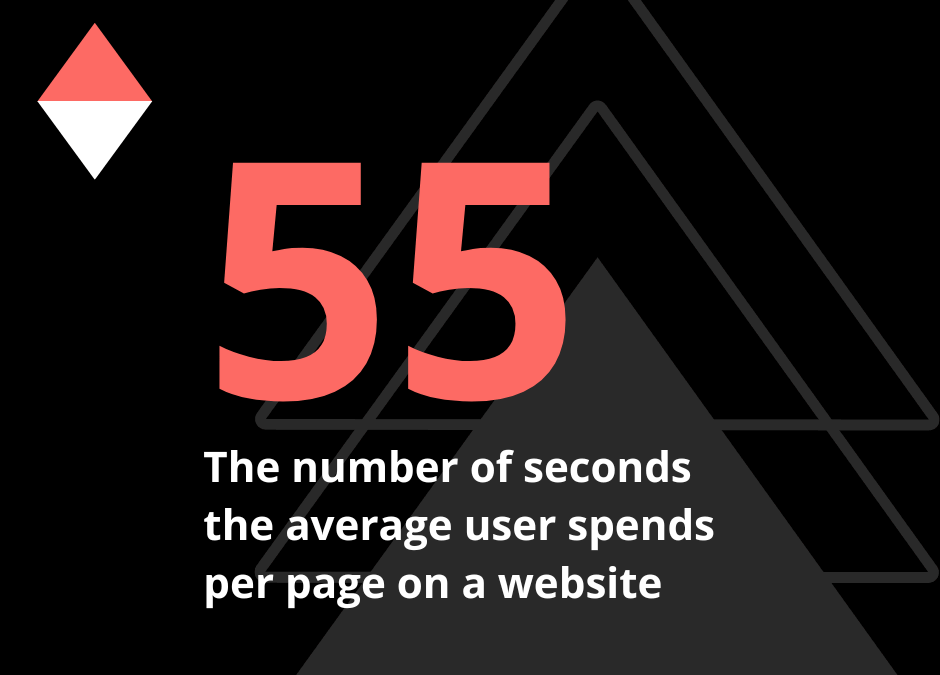
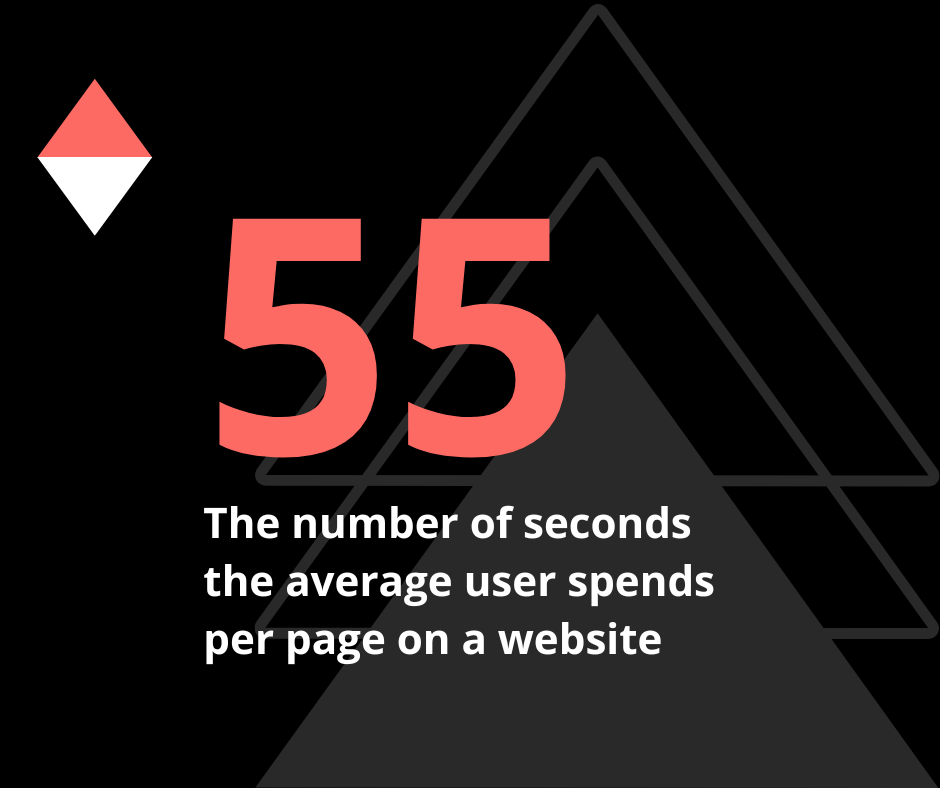
Here’s a crazy statistic to get your brain humming. According to Contentsquare’s 2022 Digital Experience Benchmark Report, the average user only spends 55 seconds per page on a website.
That’s just enough time to wave hello to a neighbor, pet a cat, have a glass of water, or hug someone nearby, but not enough time to do any of those things together!
Folks, that’s how much time you have to get the average user to do something of value to your business on your website.
A user will not, and I repeat WILL NOT read through huge blocks of text to learn everything about your company.
Let’s rip off another band-aid…potential customers don’t care about you or what you do!
The fact is consumers care about themselves exclusively. They want to know what problem your business can help them solve. They want to know why they should trust you, and they want validation that choosing you is the right decision.
This is why business owners shoot themselves in the foot when they design their own websites. They aren’t able to build a website impartially. They design websites that serve their own interests and agenda. They design websites for themselves.
The secret is that they are not their target customer!
Web Design Requires Specific Skills
While the advent of user-friendly web design software has revolutionized the number of websites that exist out there in the world.
When WordPress was launched in 2003 there was a total of 40,912,332 registered domains in existence. In 2018, that number climbed to 1,630,322,579. I’ll give you a second if you need to pick your jaw up off the ground.
Of those websites, the vast majority are most likely designed by non-design professionals. Inspired by the ease of web design software, many a business owner has been inspired to put on their creative cap and spend hours perfecting, polishing, and just plain having fun watching their designs unfold before them.
And they all share the exact same end result, a website that receives no revenue and generates little to no traffic at all. So what went wrong?
Web design software gives you the tools to design a website, but they do not give you the skills, experience, or marketing knowledge to design a successful website.
Code and Customization
What happens if you invest a ton of time into creating your business website, only to find out that the out-of-the-box version doesn’t include the ability to allow customers to perform a necessary task vital to the success of the website?
For most business owners, this means either trying to find a way to run their business without this necessary functionality or reaching out to a web designer to solve this issue for them.
But how many hours did the business owner spend searching the web to try and find a solution? What other business functions did they forgo in order to arrive at this conclusion?
Another harsh reality here is that all websites involve some level of custom coding. The reason is that every business is different. If they weren’t then there probably wouldn’t be much competition in your industry.
So, unless you want to learn how HTML, CSS, or Javascript, save yourself the hassle, headache, and lost potential earnings and just hire a web design professional to assist you.
SEO Matters. You’re Not an Expert (and That’s Ok)
Search engine optimization (SEO) is one of the most important aspects of website design and development, but it’s also one of the most difficult to learn.
That’s because it involves understanding how search engines work and what people are searching for. It’s also important to know how to use keywords effectively, and how to make your website easy to use and navigate.
But most importantly, SEO is always changing. Google makes hundreds of algorithm changes per year, and keeping up with all of those changes is a full-time job.
Unless you’re willing to put in the time and effort to learn SEO or hire someone who already knows how to do it, you’re better off leaving it to the professionals.
Search engine optimization (SEO) is one of the most important aspects of website design and development, but it’s also one of the most difficult to learn.
There are literally thousands of guides, tutorials, online classes, podcasts, and videos out there each trying to provide useful information on how to leverage SEO for your business website.
While I always encourage every one of my clients to familiarize themselves with SEO fundamentals, I have run across plenty of business owners that have done themselves irrevocable harm when tackling SEO themselves.
Yes, there is a danger in doing your own SEO improperly.
Some of these dangers include:
- You could get penalized by Google
- Your website could get banned from Google
- Your site could get de-indexed by Google
- Your rankings could suffer
- You could lose money
Getting a website back within Google’s index is a nightmare, even for expert SEOs. You could literally spend thousands of dollars for a solution and there’s no guarantee it will work.
The most difficult part of SEO is that it pulls so many disciplines under one umbrella. To be successful you need to have a strong content creation, content marketing, consumer psychology, web development, and analytics background.
Each of these will be called into use on a daily basis as you try to outsmart your competitors who are using professional SEO services to outrank your website.
My sage advice? Don’t put yourself in this position.
Hire an experienced SEO professional to help you rank your website and avoid the headache, heartache, and potential financial ruin of doing it yourself.
Analytics: How Much Do You Know About Collecting Data?
Let’s open this section with a story from one of my oldest clients, Alex.
“When I first started my business, I was determined to do everything myself. I was going to be the one-man-show and learn how to code, design, and market my own website.
I was so proud of myself when I finally finished building my website. It was exactly how I wanted it to look and it was perfect! or so I thought.
I didn’t realize how important analytics were until after I had launched my website. I wasn’t tracking how many people were visiting my site, how long they were staying, or what pages they were visiting.
I didn’t know how to track any of that information, and as a result, I had no idea how well my website was performing.
I was lucky enough to have a friend who is an expert in SEO and analytics who helped me set up Google Analytics and start tracking the data that mattered.”
This story perfectly captures the importance of having a professional guide you through not just the proper setup of your analytics account, but how to collect the right data that applies to your business, and how to analyze that data to understand what parts of your website are working and what parts are not.
I have hundreds of examples of business owners that build their own websites and have no idea that their website is performing poorly until I show them the numbers. Do you fall into this category?
What Happens When Something Goes Wrong?
Oh boy, my website stopped working!
Who do you call?
Well, the answer, sadly, is yourself. When you design your own website, you are the one responsible for fixing it when something goes wrong.
This is where that technical skill set would really come in handy. Yes you can probably scour the web for a solution to your issue, or you can try to contact the developers of the software design platform you used to create your website, but what is their response time? How long will it take them to resolve this issue once they finally get around to addressing it?
They say time is money, and that is especially true when your website is down and you’re losing traffic and potential customers. Not to mention the time you are taking out of running your business. How much is that costing you?
If you have a professional design and development team on your side, they can quickly help you resolve any issues you have with your website so you can get back to business as usual.
Access to the Right Tools
Prepare yourself for another jaw-dropping insight. As a web design agency, we easily spend over $1K per month on all the tools we need to make effective business websites for our clients.
We don’t mind the expense as it makes our lives easier and this amount is very little when spread over hundreds of clients and projects.
When you build a website for yourself, however, the expense is only spread over one client, which is you.
Now I know what you’re saying, “That’s fine, I probably won’t need that many tools to develop my website”. Oh, sweet summer child, I was once like you.
When I first started building websites, I thought the same thing. As it turns out, if you want to compete with your competitors on a design level, you’re going to need photo editing software, graphic design tools, email automation software, CRM software, analytics tracking software add-ons, live chat software, website security features, and so much more.
This doesn’t even take into account the SEO software needed to do any kind of respectable keyword research or the paid advertising software you’ll need to make effective use of Google Ads and Facebook Ads.
When you hire a professional web designer, it’s their responsibility to pay for those subscriptions and tools. Even if they build the cost of those tools into the price of your web design, it will be pennies rather than hundreds of dollars. As I said, they can spread it over hundreds of clients each year.
How Valuable is Your Time?
We touched on this in a few sections of this post but we should take a moment to flesh this concept out a bit.
How much is your time worth? Do you charge your clients by the hour, by the project, or by some other metric?
No matter how you slice it, time is money. You only have so many hours in a day and if you’re spending those hours trying to learn how to design and code a website, how much are you really making?
Are you investing time into a skill you’re never going to use again?
How many new clients could you take on if you weren’t spending all your time working on your website?
How many more products could you sell or how much more revenue could you generate if you could focus your attention on other aspects of your business?
Odds are, the answer is “a lot”. If you were the CEO of your company and you had a board of directors to answer to, would you feel confident telling them how you’ve been spending your time designing a website for the last couple of months? What do you think their response would be?
You guessed it…time to find another CEO!
Website Leads or Sales…Nope!
One of the most costly and difficult aspects of running a business is customer acquisition.
Larger companies spend hundreds of thousands of dollars each year on marketing, advertising, and lead generation. They have teams of people dedicated to nothing but bringing new business through the door.
When you’re a small business owner, you don’t have the luxury of large budgets to spend on customer acquisition.
Your goal should be to maximize the marketing budget you do have to bring people to your website.
But what’s the plan once they get there? Do you have something of value that will compel them to stay on the website? Is the goal of each page obvious to the user? How do you use this visual space to nudge a visitor towards a specific action? How do you test whether or not your design is effective and what parts might be hindering a visitor from taking a specific action?
Not having clear and targeted answers to these questions is another reason why your DIY business website was dead in the water before you even got it launched.
Your Competitors Will Win Every Month
If your competitors have professionally built websites, they are going to beat you in search rankings, lead generation, sales, and customer retention every month.
There’s just no way around it.
If you’ve ever heard the expression “you get what you pay for”, trust me it applies here. Your competitors invested in their business. They chose to go with experts that have a proven track record of building business websites.
They decided to hire professionals that have seen it all and done it all when it comes to designing websites that allow for specific business objectives to be accomplished, recorded, and refined.

Your failure to make the same investment will ultimately have the same result. As Spock would say, “Logic is the beginning of wisdom, not the end of it”.
Don’t let your competitors win because you wanted to save a little money. If you’re serious about your business, invest in your business.
Increased Risk of Security Breach
One final reason why designing your own business website is a big mistake is that it puts you at an increased risk of security breaches.
When you try to do everything yourself, you’re more likely to make mistakes. These mistakes could be something as small as forgetting to update a plugin or leaving a test page live on your site.
Both of these things could create vulnerabilities that hackers can exploit to gain access to your website or worse, your customer’s personal information.
If you’re not a security expert, you’re simply not equipped to design a website that’s going to be secure from attack.
Hackers are becoming more sophisticated and they’re targeting small businesses more and more. Don’t take the risk of being one of their victims.
Conclusion
While these are just some of the reasons why you should take the initiative to hire a professional website designer to build your business website, the list could literally go on and on.
The bottom line is this: if you want your business to succeed, don’t cut corners.
Invest in your website and make sure it’s done right. It will be one of the best investments you ever make.


